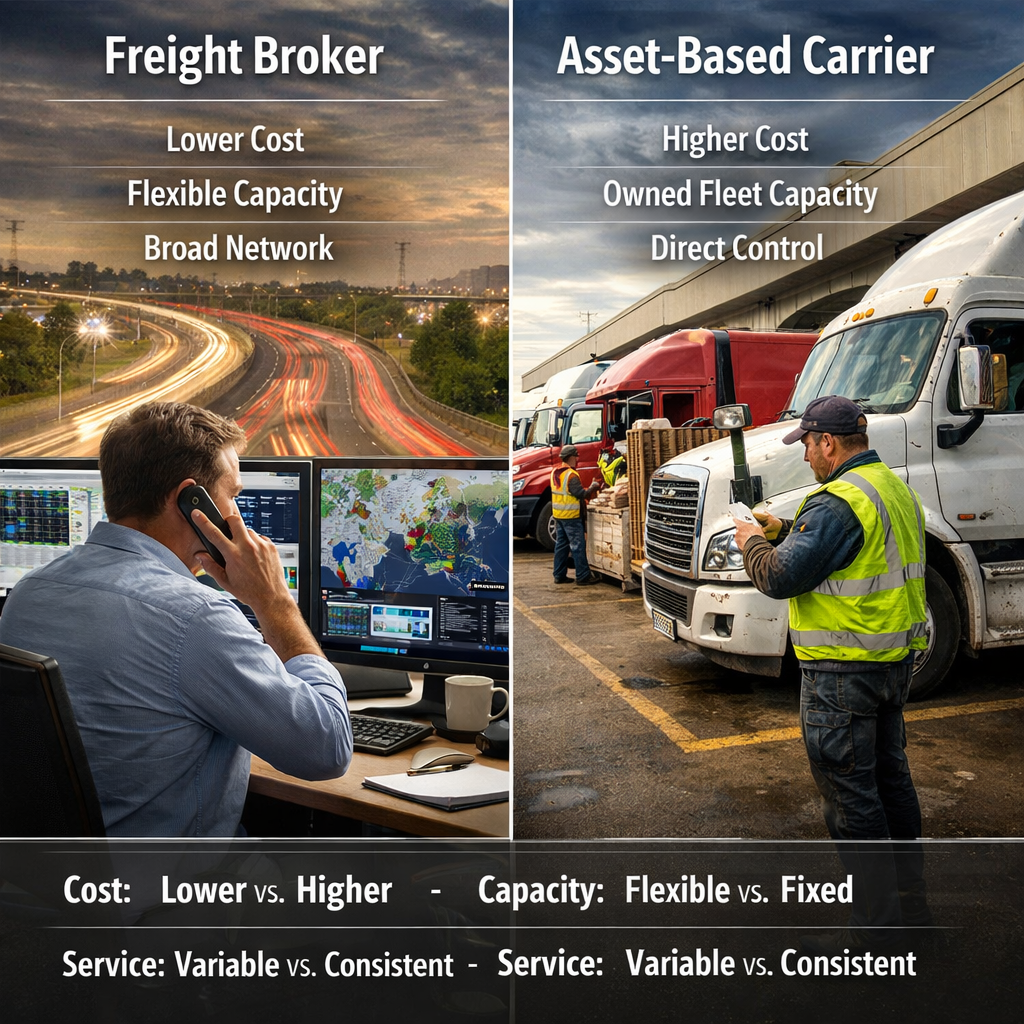
Two Provider Models. Different Strengths.
Shippers often use the terms freight broker and asset-based carrier interchangeably, but they are not the same. They solve different transportation problems and create different trade-offs in cost structure, capacity access, and operational control.
If you award freight without understanding that difference, you can end up paying for the wrong kind of coverage — or exposing important loads to more risk than you intended.
This guide breaks down what each model is, where each one adds value, and when a hybrid approach makes more sense than choosing one or the other across your entire network.
The right choice is not about which model sounds better. It is about which model fits the service risk, lane profile, and capacity needs of the freight you are moving.
What Is a Freight Broker?
A freight broker does not typically move freight on its own trucks. Instead, the broker arranges transportation by sourcing capacity from carriers and managing the shipment on the shipper’s behalf.
In practice, that means a broker’s value comes from network access, pricing coverage, lane flexibility, and execution support rather than from owned equipment.
A strong brokerage model can give you:
- Access to a broad carrier network across many lanes and markets
- Flexible coverage for overflow, irregular freight, and non-core lanes
- Faster sourcing when committed dedicated capacity is not justified
- Optional support across truckload, LTL, intermodal, or specialized freight depending on the provider
The trade-off is that a broker’s capacity depends on carrier relationships and market conditions. When the market tightens, the broker must still find a truck in the same environment everyone else is buying from.
What Is an Asset-Based Carrier?
An asset-based carrier operates its own trucks, trailers, and driver network. The provider is not just coordinating transportation — it is physically moving freight on equipment it controls.
That usually gives shippers:
- More direct operational control over committed freight
- Greater consistency on lanes served by the carrier’s fleet
- Stronger visibility into service execution on owned capacity
- More stability on core lanes where the carrier already has fleet density
The trade-off is that an asset-based carrier’s owned network is not infinite. Coverage is strongest where the fleet is already positioned and where the provider has real operating density. Outside that footprint, flexibility may be lower unless the provider also has brokerage capability.
Side-by-Side Comparison
| Freight Brokerage | Asset-Based Carrier | |
|---|---|---|
| Core Function | Arranges transportation through carrier network | Moves freight on owned equipment |
| Capacity Source | External carriers | Internal fleet and drivers |
| Lane Flexibility | Usually higher | Strongest where fleet density exists |
| Operational Control | Indirect | More direct on owned freight |
| Market Exposure | Higher in tight markets | Lower on freight covered by owned assets |
| Best Fit | Variable, overflow, or broad geographic freight | Core lanes with stable volume and service sensitivity |
When Freight Brokerage Is the Better Fit
Brokerage is usually the better answer when your network needs flexibility more than committed fleet control.
- Freight is irregular, seasonal, or low-frequency by lane
- You need broad market coverage across many origins and destinations
- You need overflow support beyond committed core capacity
- You want optionality rather than locking every lane into a fixed fleet structure
For many shippers, brokerage is not a fallback. It is the right operating tool for the part of the network where variability is the defining feature.
When an Asset-Based Carrier Is the Better Fit
Asset-based capacity is usually the better answer when consistency and operational control matter more than flexibility.
- You have repeatable volume on defined lanes
- The cost of service failure is operationally high
- Driver familiarity, schedule discipline, and execution consistency matter
- You need stronger confidence that core freight will move in tighter markets
For production-sensitive freight, customer SLA freight, or repeat network lanes, asset-based service often reduces exposure that would otherwise sit on the spot or brokered market.
Need help deciding which model fits your freight?
The right answer depends on lane stability, service sensitivity, and how much market exposure you can afford to carry across your network.
What the Difference Costs You
The cost difference is not just the quoted rate. It is the operational consequence of how the freight is covered.
Choosing brokerage where committed asset capacity is needed can expose core freight to pricing spikes, inconsistent service execution, and capacity gaps when markets tighten.
Choosing asset-based capacity where flexibility is more important can lock you into a structure that is too rigid for the freight actually moving.
The real question is not “Which model is cheaper?” The better question is “Which model creates the lowest total operating risk for this lane?”
Why a Hybrid Model Is Often Stronger
For many shippers, the best answer is not brokerage or asset-based. It is both — used intentionally.
A provider with both capabilities can place the right freight on owned equipment while using brokerage for overflow, seasonal spikes, unusual lanes, or freight outside the core operating footprint.
That creates a more practical structure:
- Asset-based coverage for core lanes
- Brokerage flexibility for non-core or variable freight
- Less unnecessary market exposure on critical loads
- Less wasted committed capacity on inconsistent freight
Questions a Shipper Should Ask
- Which of my lanes are stable enough to justify committed asset coverage?
- Which of my lanes are too variable for a fixed fleet structure?
- What happens to service when markets tighten?
- Am I buying flexibility where I need consistency?
- Am I buying committed capacity where I really need optionality?
Talk to Our Team About Your Freight Mix
Freight brokerage and asset-based transportation both have a place in a well-structured network. The value comes from assigning the right model to the right freight.
Brown Integrated Logistics works with operations leaders to evaluate core lanes, variable demand, and the right balance between committed capacity and flexible coverage.
Talk to Our Team to discuss how your freight should be structured.