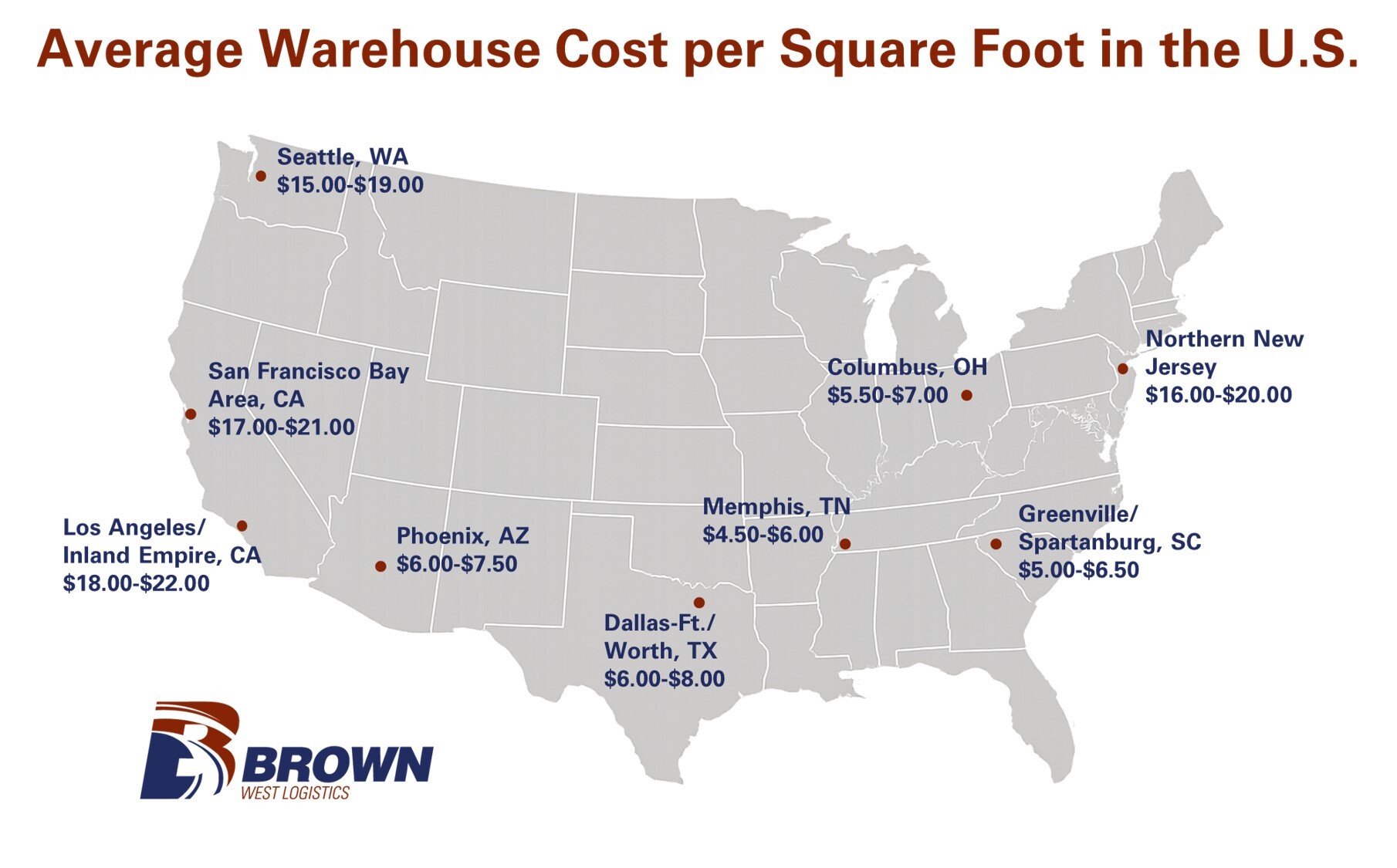
Average Warehouse Cost per Square Foot in the U.S.
Warehouse costs vary widely across the United States, driven by real estate demand, labor availability, transportation access, and market saturation. For logistics and supply chain professionals, understanding the average warehouse cost per square foot — and which markets offer the strongest value — is an important part of making smarter site selection decisions.
This guide breaks down average warehouse rates by region, highlights some of the most expensive logistics hubs in the country, and points to more affordable alternatives that still offer strong distribution reach.
Average Warehouse Cost per Square Foot (2025)
As of early 2025, the national average warehouse rental rate is approximately $9.00 per square foot, up from $7.50 just two years earlier. Actual pricing can range from under $5.00/SF in some rural markets to more than $20.00/SF in high-demand urban logistics hubs.
Warehouse cost per square foot is only one part of the equation. The right market also depends on labor, infrastructure, speed to customer, and facility availability.
Highest-Cost Warehouse Markets in the U.S.
These markets command a premium because of their proximity to large population centers, port access, and strong last-mile delivery demand.
Los Angeles / Inland Empire, CA: $18–$22/SF
Unmatched access to the Ports of Los Angeles and Long Beach, along with major West Coast distribution corridors, keeps this market at the top end of the cost range.
Northern New Jersey: $16–$20/SF
Direct access to New York City and Port Newark makes this one of the most important and most expensive logistics markets on the East Coast.
San Francisco Bay Area, CA: $17–$21/SF
Limited industrial inventory and strong regional demand continue to push warehouse costs higher.
Seattle, WA: $15–$19/SF
Port activity, high land values, and limited developable space all contribute to premium warehouse rates.
Affordable Markets with Strong Distribution Value
Lower-cost markets can still offer strong regional or national distribution potential when they have the right highway, rail, port, or parcel infrastructure in place.
Dallas-Fort Worth, TX: $6–$8/SF
A central location, abundant industrial space, and strong multimodal transportation access make Dallas-Fort Worth one of the country’s most attractive value markets.
Columbus, OH: $5.50–$7.00/SF
Often called the “Crossroads of America,” Columbus offers one-day reach to a large share of the U.S. population and remains highly competitive on cost.
Greenville-Spartanburg, SC: $5.00–$6.50/SF
Rapid industrial growth, inland port access, and strong proximity to Southeastern markets make this a compelling lower-cost option.
Phoenix, AZ: $6.00–$7.50/SF
Phoenix remains an attractive overflow and alternative market for companies that want Western reach without California-level lease rates.
Memphis, TN: $4.50–$6.00/SF
With FedEx’s global hub and strong national distribution reach, Memphis continues to offer strategic value at a lower cost point.
| Market | Cost Range ($/SF) | Region Type | Distribution Advantage |
|---|---|---|---|
| Los Angeles / Inland Empire, CA | $18.00–$22.00 | High-Cost | Port access, dense urban demand |
| Northern New Jersey | $16.00–$20.00 | High-Cost | Proximity to NYC and Port Newark |
| San Francisco Bay Area, CA | $17.00–$21.00 | High-Cost | Urban proximity, constrained industrial supply |
| Seattle, WA | $15.00–$19.00 | High-Cost | Port access, tight land supply |
| Dallas-Fort Worth, TX | $6.00–$8.00 | Low-Cost | Central location, strong transport links |
| Columbus, OH | $5.50–$7.00 | Low-Cost | Strong one-day population reach |
| Greenville-Spartanburg, SC | $5.00–$6.50 | Low-Cost | Inland port access, Southeast regional reach |
| Phoenix, AZ | $6.00–$7.50 | Low-Cost | Lower-cost alternative to California |
| Memphis, TN | $4.50–$6.00 | Low-Cost | FedEx hub, national distribution reach |
Need help evaluating warehouse markets?
Market averages provide useful context, but the right warehousing decision also depends on your inventory profile, service requirements, labor needs, and customer geography.
Key Considerations Beyond Price
Rental rate is important, but it should not be the only factor driving your decision. A lower-cost market can become more expensive in practice if labor is tight, transportation access is weak, or modern space is limited.
- Labor market availability and wage rates
- Proximity to major highways, rail, and ports
- Tax incentives and utility costs
- Availability of modern Class A warehouse space
Conclusion
Understanding warehouse pricing trends is more important than ever as supply chains adapt to changing consumer expectations and shifting geographic demand. While coastal hubs continue to command premium rates, inland and secondary markets can offer strong value with wide-reaching distribution capabilities.
Whether you are expanding your footprint or evaluating your first facility, the goal is to balance cost with access, labor, and logistics infrastructure in a way that supports long-term performance.